What Is Select Fill, and Why Do Houston Builders Require It?
Select fill is a low-plasticity mix of sandy clay or clayey sand that engineers require under slabs, building pads and pavement. The name means what it says: material selected from the right stratum of a pit and tested to prove it, unlike common fill dirt, which is whatever came out of the ground. Around Houston, if your plans mention a pad, they almost certainly mention select fill.
We dig it every day at our select fill and dirt sales pits in southeast Fort Bend County, so here is the plain-language version of what the spec sheets mean.
Why do Houston builders require select fill at all?
The Houston region sits on expansive clay. That soil swells when it rains and shrinks when it bakes, and a real Houston geotechnical report will describe native ground with a plasticity index around 18 to 20 as having “moderate potential for shrinking and swelling.” A concrete slab poured straight onto ground like that rides every one of those moisture swings.
The fix is a buffer the weather cannot push around: a pad of low-plasticity select fill, placed in thin layers and compacted hard. It carries the load, drains predictably, and barely moves as moisture changes. That is the whole idea, and it is why the engineer will not trade it for cheaper dirt.
What actually counts as select fill?
There is no single national recipe, but Houston-area specs converge tightly. A private geotechnical report for a Houston commercial site calls for fill with a liquid limit under 35 and a plasticity index between 7 and 20. The City of Tomball’s public works standard defines select backfill the same way: clayey gravel, sand or lean clay with a plasticity index between 7 and 20. TxDOT’s statewide embankment spec caps its Type A granular material at a plasticity index of 15.
Read those numbers as a band. Too much plasticity and the material behaves like the swelling clay you are trying to escape. Too little and it will not bind. The 7 to 20 window is the sweet spot two independent Houston-area authorities landed on separately.
The spec also says what select fill cannot contain: no vegetation, no debris, no chunks bigger than about 4 inches, no contaminated material. Clean mineral soil only.
How is select fill placed and compacted?
Buying the right dirt is half the job. The other half is how it goes down:
| Step | What the spec typically requires |
|---|---|
| Subgrade prep | Scarify the existing ground about 6 inches deep and recompact it first |
| Lift thickness | Loose layers no more than 8 inches thick |
| Compaction | At least 95 percent of maximum dry density (ASTM D-698); TxDOT requires 98 percent for its Type A |
| Moisture | Between optimum and about 4 percent above optimum while compacting |
| Verification | Density tested lift by lift in the field |
Too dry and the material will not bond. Too wet and it pumps under the roller. A pad built to this standard holds its elevation and gives the foundation crew a surface the soils engineer will sign off on. This placement work is its own trade, which is what our site prep and building pads service does start to finish.
Select fill vs the other dirt on the price list
| Material | What it is | Where it belongs |
|---|---|---|
| Select fill | Tested low-PI sandy clay | Under slabs, pads, pavement, anything structural |
| Bank sand | Screened sand, PI of 7 or less | Trench backfill, bedding, leveling |
| Common fill | Untested subsoil | Raising grade, low spots, non-structural volume |
| Topsoil | Organic growing layer | The top few inches, for grass, never under concrete |
Price follows the testing. Published Houston-area retail numbers in 2026 run from about $24 per cubic yard for select fill at a city landscape yard to roughly $50 per yard out in Fort Bend County, with units and delivery terms varying by seller. For what whole truckloads cost and why hauling drives the total, see our Houston fill dirt cost guide.
Where the material comes from matters
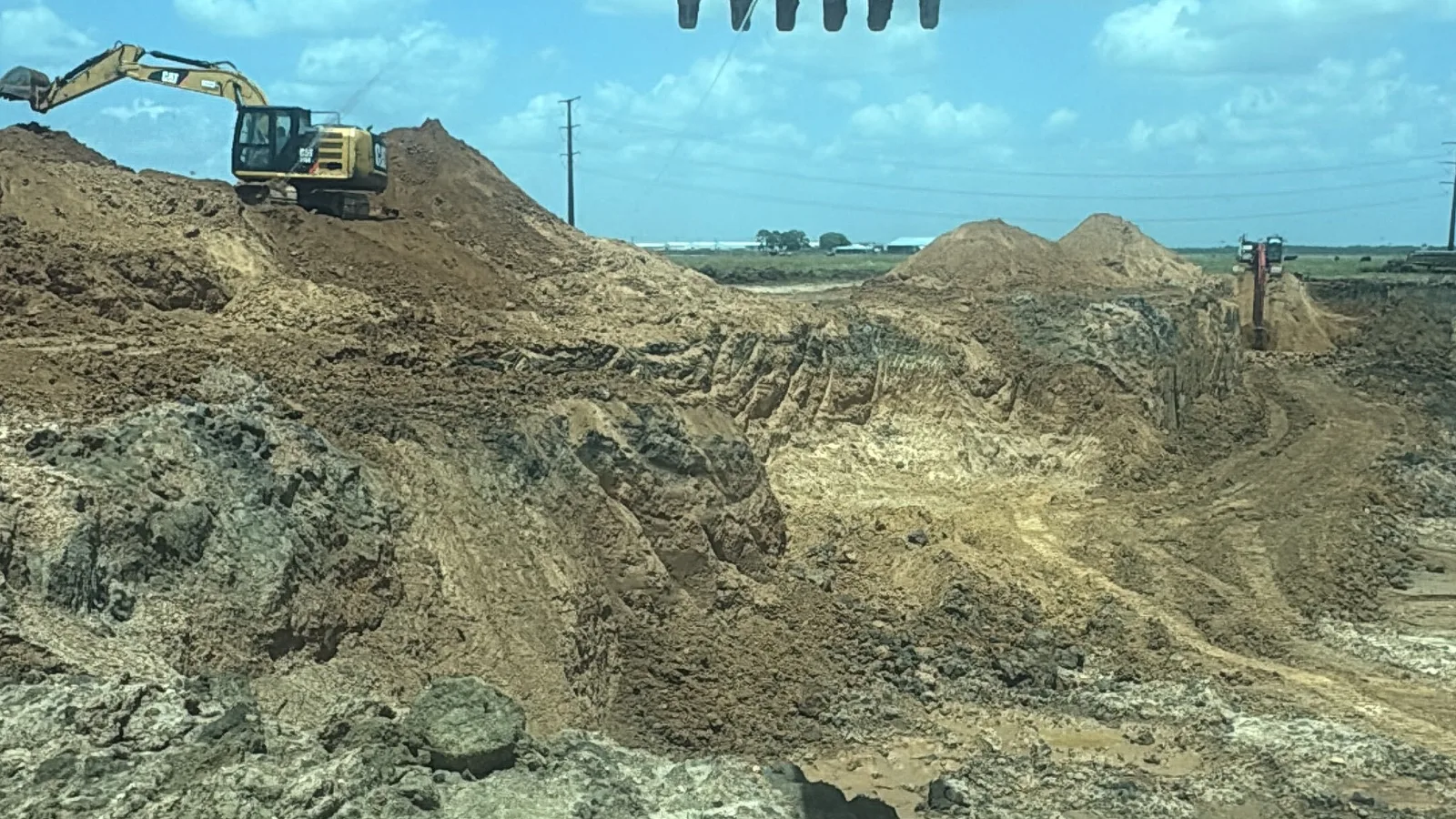
Select fill is dug, not manufactured. A pit operator opens the face of the pit, identifies the stratum that passes the tests, and digs that layer selectively. Municipal specs even require delivery tickets naming the source location for off-site fill, because dirt with no known source is dirt an inspector can reject.
That is the practical case for buying from the pit owner. We control which stratum gets loaded at our two Fort Bend County pits, the material rides our own tandem trucks, and volume orders are our normal business. If a builder, engineer or landowner spec is sitting on your desk, call (281) 750-6510 and we will talk through the material and the load count.