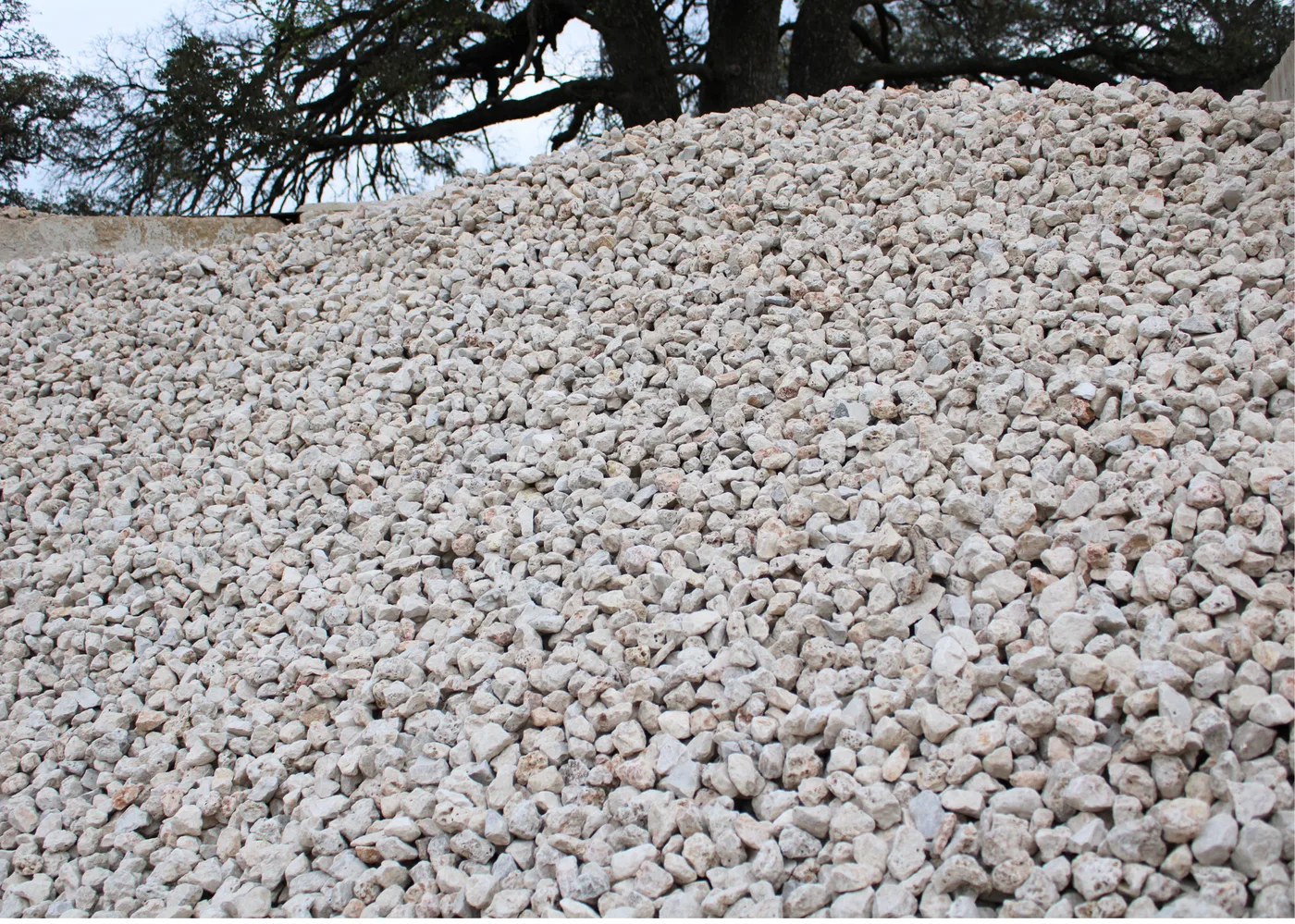
Caliche vs Crushed Concrete vs Limestone: What Should a Texas Ranch Road Sit On?
Three materials build most ranch roads in Texas: caliche, crushed concrete and crushed limestone. On the Gulf Coast the practical ranking surprises people: crushed concrete is usually the value pick, limestone is the premium spec, and caliche, the default answer in West Texas, often loses its price advantage by the time it is trucked here. And none of the three survives without the thing this article ends on: drainage.
Road building is standing work for our ranch roads and road base crews, so here is the comparison we walk customers through.
What each material actually is
Caliche is natural gravel and rock cemented together with calcium carbonate, dug from pits across West and South Texas. It grades and packs into a hard crust, cheap and effective where it is local: raw run-of-pit caliche can cost single digits per ton at the source.
Crushed concrete is demolition concrete crushed to size, usually with fines that let it re-bind almost like fresh rock as it compacts. Houston generates a constant supply of it, which is exactly why it is the Gulf Coast’s abundant, local base material.
Crushed limestone base is quarried rock crushed with fines, the material the TxDOT flexible base spec was written around. In Texas trade language, flex base and road base are the same thing; limestone is simply the classic version of it.
What they cost, honestly
As 2026 market ranges, not our quote:
| Material | Typical per-ton range | Gulf Coast reality |
|---|---|---|
| Crushed concrete | $10 to $25 | Locally abundant, shortest hauls |
| Caliche | $14 to $28 near the pits | Freight from West or South Texas eats the savings here |
| Crushed limestone | $18 to $38, higher retail | The premium, uniform spec material |
Two suppliers’ published comparisons put recycled crushed concrete 20 to 50 percent under limestone for comparable base performance. Delivery adds $50 to $150 or more per load depending on distance, and small-quantity retail pricing runs several times bulk truckload rates, which is why road jobs buy by the truckload.
The freight point deserves its own sentence: base rock is cheap and heavy, so the haul often costs as much as the rock. Material that is local wins. Around Houston that is crushed concrete and limestone, hauled short. We run the trucking ourselves through our dump truck hauling fleet, which keeps that half of the bill inside the same quote.
How thick the base needs to be
Depth is where ranch roads are won or lost, and it keys off the heaviest thing that will ever use the road, not the average day:
| Traffic | Compacted base depth |
|---|---|
| Pickups, UTVs, light daily use | 4 to 6 inches |
| Loaded stock trailers, hay trucks, tractors | 6 to 10 inches |
| Tandem dump trucks, rigs, construction traffic | 10 to 12 inches or more |
Our own tandems are the heavy case, so we build access roads to the standard our trucks need to survive. Soft Gulf Coast clay subgrade pushes depths toward the high end; a thin base over wet gumbo just disappears into it.
Durability and the mud question
On maintenance cycles, published supplier guidance favors the crushed materials: crushed concrete commonly runs five-plus years between major maintenance passes, while caliche surfaces tend to want regrading every two to three years, and caliche gets slick when wet and dusty when dry. Limestone and crushed concrete both hold a harder, more all-weather crust.
But when a ranch road turns to soup, the material is rarely the real culprit. A road laid flat on this country’s clay traps water beneath it, the clay softens, and the base pumps down into the mud while the mud pumps up. The fix is shape: a crowned surface with 3 to 4 percent fall to each side, side drainage that carries water away, and enough compacted depth for the loads. Get the shape right and any of the three materials serves for years. Get it wrong and the best limestone money can buy will vanish by spring.
That is why our road work starts with the subgrade and the crown, then the base in compacted lifts, and concrete only where use is heaviest, an upgrade path covered on the service page.
The road-sized number
Tons-per-material is the wrong final unit; roads price by their length. Published figures for rural gravel road construction run about $5 to $10 per linear foot for a 12-foot road, and $21,000 to $65,000 per mile for large-property roads. A half-mile ranch entrance is a real project, which is why it pays to build it once, on the right base, with the drainage done.
If the road is anywhere southwest of Houston, call (281) 750-6510. We will look at the route, the loads it has to carry and the water it has to shed, and quote the road with material and trucking in one number.