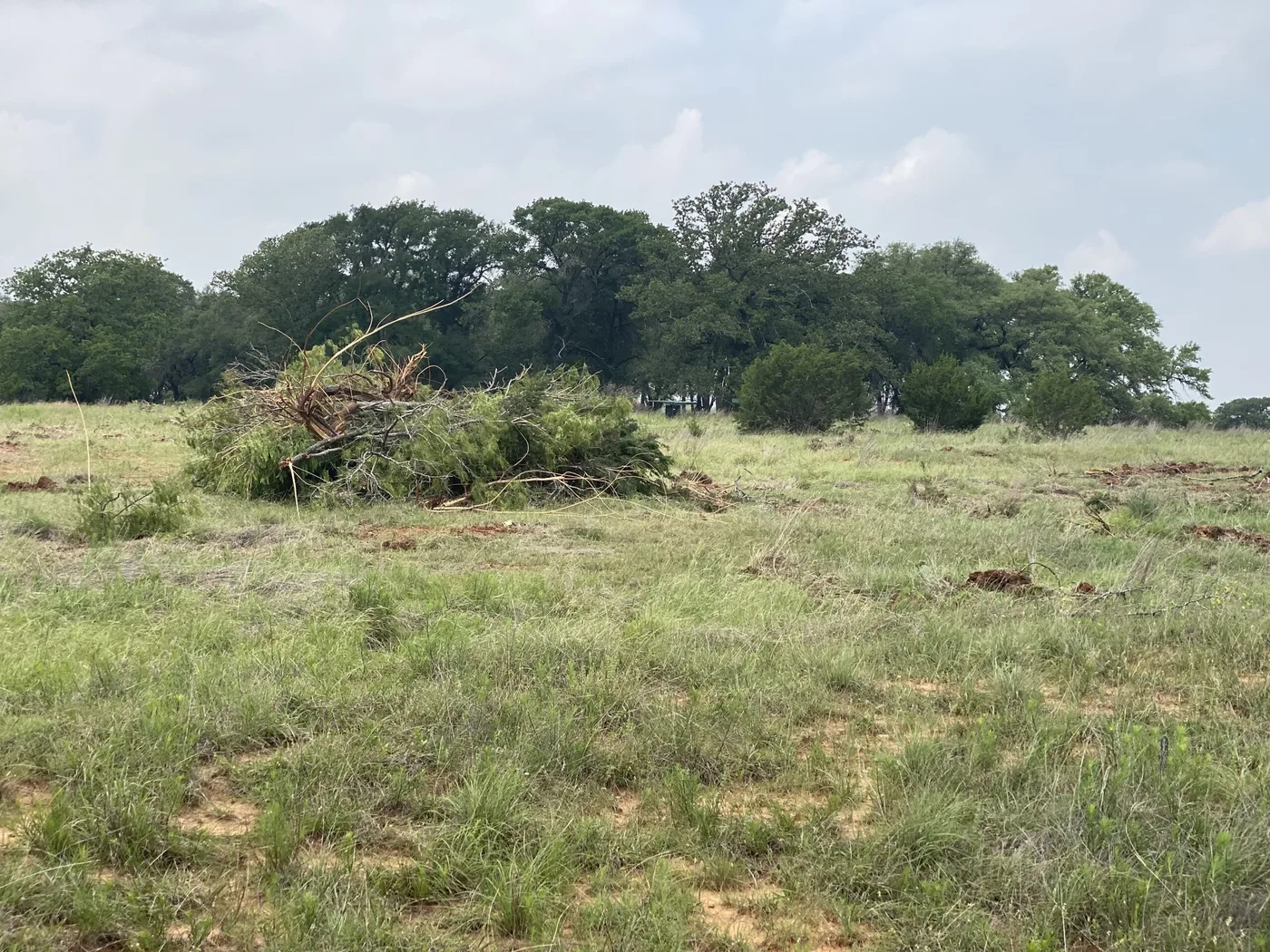
How Much Does Land Clearing Cost Per Acre in Texas?
Land clearing in Texas commonly runs $1,500 to $8,000 per acre, and around Houston’s flat coastal counties most jobs land between about $1,200 and $3,500 an acre for light to medium growth. The honest complication is that method changes both the price and what you actually own afterward, and that is where clearing quotes stop being comparable.
Clearing is daily work for our land clearing crews, so here is the market laid out straight, including the parts that favor the other method.
What clearing costs by brush density
Published 2026 Texas and national guides agree on the shape:
| Growth | Typical Texas range per acre |
|---|---|
| Light brush and small saplings | $1,200 to $3,000 |
| Medium brush, mixed small trees | $2,000 to $5,000 |
| Heavy timber and thicket | $3,500 to $8,000 and up |
Houston-area coastal ground tends toward the low half of each band because the terrain is flat and access is good. What pushes an acre up-column around here is the growth itself: mesquite, huisache, yaupon and Chinese tallow thicken fast in the river bottoms of Fort Bend, Brazoria and Wharton Counties.
The method question: what stays in the ground?
Two families of clearing dominate Texas, and they are not the same product.
Mulching grinds brush and trees where they stand and leaves the ground covered in chips. It usually prices 20 to 40 percent below cut-and-haul work, it is fast, and the chip layer suppresses regrowth for a year or so. Its honest limit: the root systems stay in the soil, and stumps are cut flush rather than removed.
Roots-out clearing, the way we do it, uses excavators and dozer-class machines to push trees over and dig the stumps and root balls completely out, then hauls or burns the debris. Published ranges put excavator clearing and grubbing roughly 30 to 60 percent above mulching per acre, with Houston-area grubbing running about $2,600 to $4,200 an acre.
So why pay the difference? Physics. Organic material left underground rots, loses volume, and lets the ground above it settle. Under pasture that means dips. Under a pad, a slab or a driveway it means cracks, years later, with the fix costing multiples of the original savings. Construction site prep specs require roots out for exactly this reason, which is why our clearing feeds straight into pad and site prep work without a second pass.
The practical rule: mulching for looks and access, roots-out for anything that will ever carry weight or hold grade.
Add-ons that show up on real quotes
Whichever method, the per-acre headline rarely stands alone:
| Line item | Typical market range |
|---|---|
| Stump removal, when not included | $100 to $800 per stump, or $500 to $1,500 per acre |
| Debris hauling | $500 to $2,000 per acre |
| Dump fees | $50 to $200 or more per truckload |
| Rough grading after clearing | $1,000 to $3,000 per acre |
| Mobilization | $300 to $1,500 |
Two of those rows work differently with us. Debris goes to our own green-waste dump, so the disposal chain is ours end to end, and roots-out clearing has no stump line because stumps leaving the ground is the method.
Why big acreage clears cheaper per acre
Moving heavy equipment costs the same whether it clears one acre or forty, so the per-acre number falls hard as jobs grow. Texas contractors publish the spread plainly: under an acre can run $3,500 to $5,000 per acre, while 50-acre projects drop to $1,500 to $2,500. That economy of scale is our home field. Our projects start around $10,000, which on clearing work means multi-acre tracts, ranch reclaim and development ground, where the mobilization cost spreads thin and the big iron earns its rate.
How fast an acre clears
Expect 1 to 3 acres a day for dozer push-and-pile on flat ground, and about half an acre to an acre a day for full roots-out clearing. Heavy timber, wet ground and haul-off distance stretch those numbers. A quoted timeline that sounds too fast for roots-out work usually is.
Getting a number for your tract
The ranges above frame any honest quote. The firm price comes from the tract: growth density, acreage, access, what happens to the debris, and whether the ground is headed for pasture or a pad. If the land sits southwest of Houston, call (281) 750-6510 and we will look at it, tell you which method the goal actually requires, and quote the whole job through to clean ground.