Do You Need a TCEQ Stormwater Permit for a Construction Site in Texas?
Yes, when the job disturbs 1 acre or more of soil. That is the trigger for a TCEQ stormwater permit, the construction general permit called TXR150000. It applies when site runoff drains to surface water in the state. A smaller job counts when it is part of a larger common plan that will disturb 1 acre or more.
Out of Needville, we clear and grade land for site prep and building pads. Every acre of that work counts toward the trigger. This post explains TCEQ’s published rules, not legal advice. Confirm your site with TCEQ or your engineer.
What counts as disturbed ground for a TCEQ permit?
More than the slab counts. TCEQ’s definition of construction activity covers clearing, grading, excavating and stockpiling fill. It also covers support areas like equipment staging, material storage, borrow areas and spoil disposal.
Add up everything the job opens. TCEQ treats a building with its parking lot and driveways as one common plan. A pile of select fill dirt waiting to be spread counts too.
Phases of one job add together. TCEQ calls separate stages or phases of one project a common plan of development. Projects a quarter mile or more apart can count separately when the ground between them is not being disturbed.
The clock starts with the first tree. TCEQ counts clearing and grubbing as the start of construction. The stormwater plan has to be in place before then. Line it up before land clearing begins.
Routine upkeep is left out. Regrading an existing dirt road to its original line and grade counts as routine maintenance.
What is the difference between a small site and a large site?
TCEQ splits regulated sites at 5 acres. A small site disturbs at least 1 acre but less than 5. A large site disturbs 5 acres or more, or belongs to a larger common plan that will.
| Small construction site | Large construction site | |
|---|---|---|
| Ground disturbed | At least 1 acre but under 5, or part of a common plan in that range | 5 acres or more, or part of a common plan of 5 or more |
| Stormwater plan (SWP3) | In place before work starts | In place before coverage and before work starts |
| NOI and fee | No NOI, so no NOI fee | NOI through STEERS: $225 online or $325 on paper |
| Site notice | Signed Form 20963, posted at least 2 days before work | Form 20961 for primary operators, Form 20962 for secondary operators, posted before work |
| Copy to the MS4 operator | Signed site notice, at least 2 days before work | Signed NOI, 2 days before work, also sent to any secondary operator |
| When it ends | Notice comes down after final stabilization, copy to the MS4 within 30 days | Notice of Termination within 30 days of final stabilization |
A small site files no NOI and pays no NOI fee. The operator writes a stormwater pollution prevention plan and puts it in place before work starts. TCEQ shortens the name to SWP3, and it is also written SWPPP.
A large site needs the same plan plus a signed Notice of Intent, or NOI. The NOI and fee go through the State of Texas Environmental Electronic Reporting System, called STEERS. An online NOI gives coverage once TCEQ confirms it received the form. There is no separate annual fee.
Both tiers send paperwork to the MS4 operator. That is the public owner of the storm sewer system the site drains into, such as a city or county. TCEQ counts gutters, streets, channels and ditches in that system. It tells operators to ask the nearest city, county or drainage district which system receives their runoff.
What does a SWPPP require on the ground?
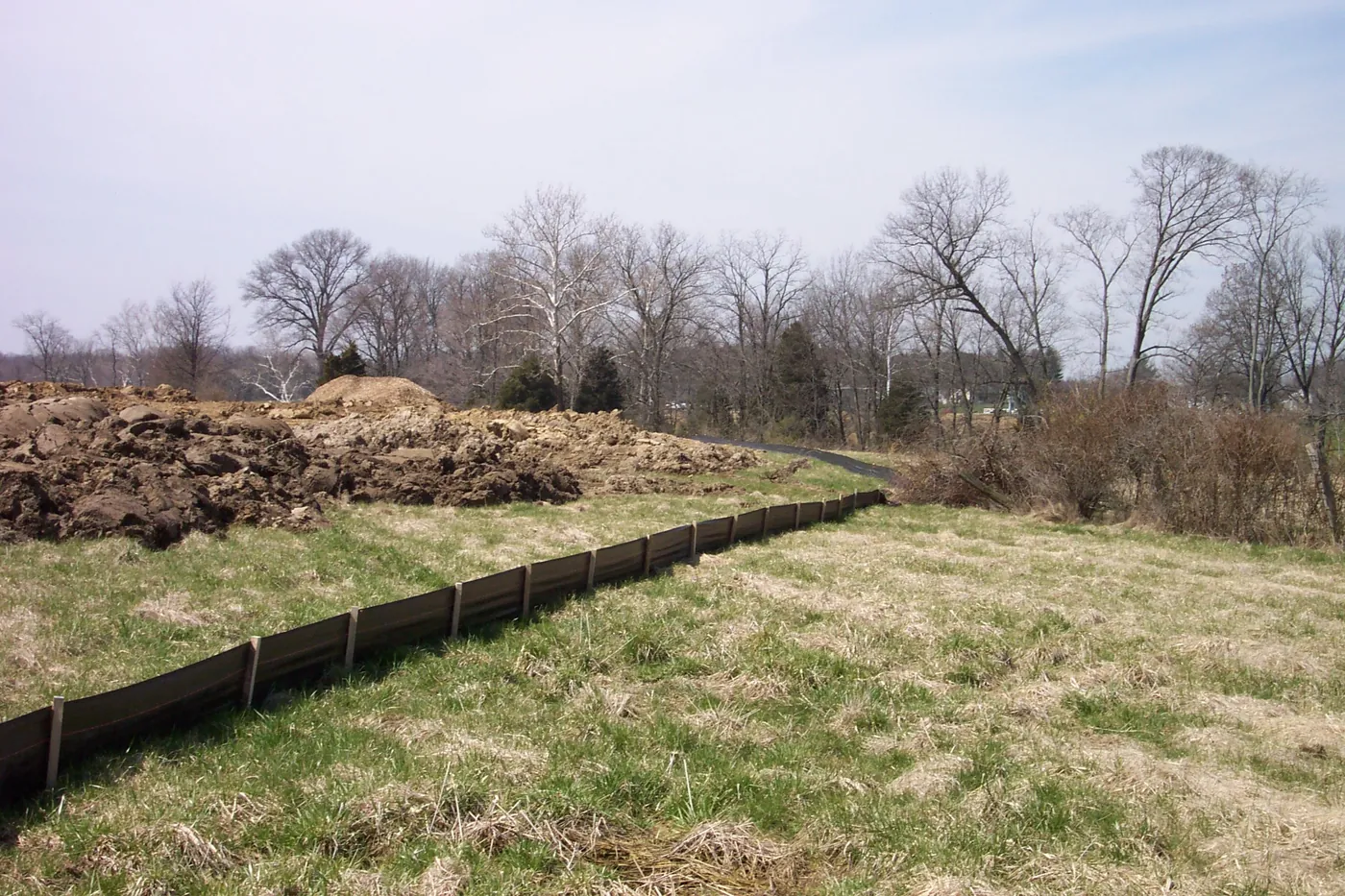
The plan has to show up in the dirt. Every down-slope edge of the work area needs a sediment control at a minimum. Silt fence or a vegetative buffer strip can fill that role. So can an equivalent control.
The permit also calls for keeping exposed soil to a minimum and limiting sediment tracked off site by vehicles. Phasing leaves your tier the same and can keep fewer acres open at one time.
A sediment basin comes in at a common drainage point serving 10 or more acres disturbed at one time. The permit requires one there where feasible. Without a rainfall calculation, it must hold at least 3,600 cubic feet per acre drained. An existing detention or retention pond may not be appropriate, the permit says.
Inspections run at least once every 14 calendar days. Another is due within 24 hours after a storm of 0.5 inches or more. A plan can instead set a fixed weekly schedule that runs in wet and dry weeks alike.
Bare ground has deadlines too. If an area will sit idle for more than 14 days, stabilizing starts by the end of the next workday. Temporary stabilization must be done within 14 calendar days of starting it.
Who is the primary operator, and who is the secondary operator?
A primary operator controls the plans and specs, or has day-to-day control of the work the plan depends on. A general contractor running the site fits that second test.
A secondary operator is often the property owner. The owner hires the general contractor or approves plan changes but has no day-to-day control on site. Secondary operators must write their own SWP3 or join a shared one.
On a large site, a secondary operator files no NOI as long as a primary operator has filed one. If there is no primary operator on site, the secondary operator is treated as the primary. An owner who hires trades directly and runs the job should ask TCEQ or an engineer which role applies.
What exceptions and waivers does TCEQ allow?
Small sites get two special options, and one is off the table here. The low potential for erosion option only works in the counties and date windows in Appendix A of the permit. Fort Bend, Brazoria, Wharton and Matagorda counties are not on that list.
The other is the Low Rainfall Erosivity Waiver. It applies when the rainfall erosivity factor, called R, stays under 5 for the whole project. The operator files the waiver form online with TCEQ. Ask your engineer whether a short job fits.
Farm work is treated differently. The permit says agricultural stormwater that is not a point source is not subject to TPDES permit requirements. Its examples include clearing ground for crops and building stock ponds. Our guide to pond permits in Texas covers the water law side of a ranch pond.
The permit also exempts construction for oil and gas exploration, production, processing, treatment or transmission. An office building at an oil and gas site still counts as construction. So do its parking lot and the roads that serve it.
When does TCEQ permit coverage end?
Coverage runs until final stabilization and a formal close-out. Final stabilization means even, perennial vegetation at a density of at least 70 percent of the native cover. Permanent measures such as riprap or gabions can count instead.
A large site files a Notice of Termination within 30 days of final stabilization. The MS4 operator gets a copy.
A small site takes down its notice, fills in the removal section and sends the MS4 a copy. That happens within 30 days, and the notice cannot come down before final stabilization. Every permit condition applies until coverage formally ends.
How long does the current TCEQ construction general permit run?
The current permit, TXR150000, took effect March 5, 2023, and expires March 5, 2028. TCEQ has begun the renewal and held a stakeholder meeting on June 9, 2026. Check TCEQ’s construction stormwater page for changes before a long job starts.
How do you plan the pad and the paperwork together?
Draw the whole footprint first: clearing limits, the pad, the drive, parking and stockpile areas. That total sets your tier. How many acres sit open at one time can bring a sediment basin into the plan.
A drive onto a public road can need its own entrance permit. Our driveway permit guide covers who issues it.
Then set the budget and the schedule side by side. Our house pad cost guide for the Houston area covers the dirt side. Have the stormwater plan and site notice ready before the first tree comes down.
We clear and grade pad sites across southeast Fort Bend County and the country southwest of Houston. Call (281) 750-6510, and we will look at the site and the dirt the pad needs.