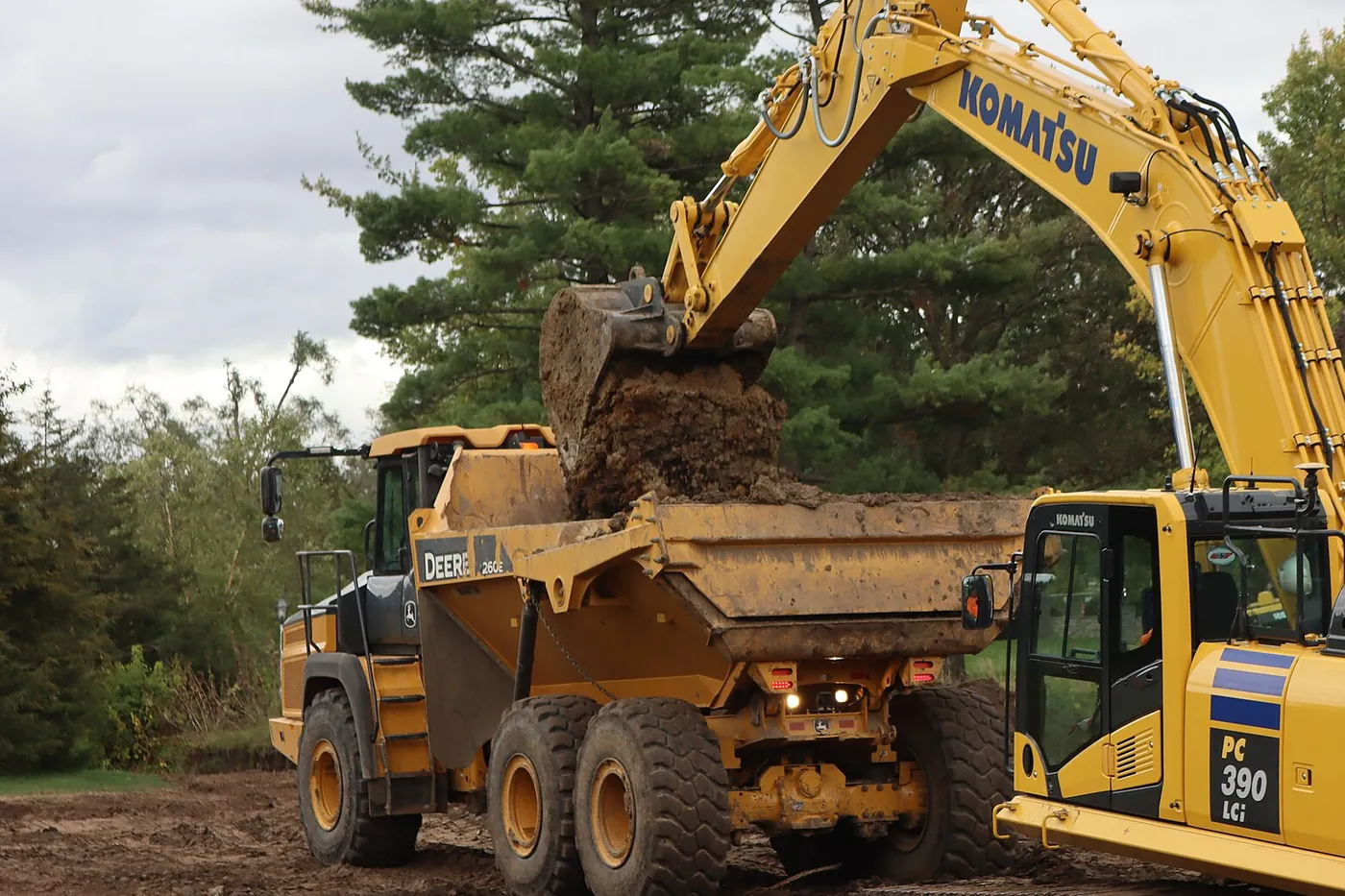
How Much Does Dirt Haul-Off Cost Near Houston?
Dirt haul-off is priced by the hour, by the load or by the yard. Machine time to load the trucks and any dump fee are extra unless the quote rolls them in. Tandem dump truck work in this market is commonly quoted at about $85 to $150 an hour. Angi’s national guide puts a full junk removal truckload of dirt at $400 to $800.
Those are published market ranges. A firm number comes from your job, mostly the yard count and the haul distance. Our dump truck hauling and haul-off service takes pond spoil, pad cut, trench spoil and wet mud off sites. We run our own tandem dump trucks and can bring the machine to load them.
How is dirt haul-off priced?
Each method counts something different, so two quotes for the same pile can look far apart. Hourly pricing counts truck time. An hourly truck bills the same rate while it waits at the loader or drives back empty.
Load pricing sets one price per truckload, which works when the distance and the dump site are known. Yard pricing counts volume, measured in the hole or in the truck. Dump sites charge by the ton, though Angi notes some landfills measure dirt in yards instead.
| Pricing method | How it is counted | What it suits | What to ask for in the quote |
|---|---|---|---|
| By the hour | Truck hours, including the empty trip back and time at the loader | Volume jobs with many loads or a long haul | When the clock starts and stops, and whether machine time to load is billed apart |
| By the load | One flat price for each truckload | A known number of loads to a known dump site | How many yards make a full load, and whether the dump fee is included |
| By the yard or ton | Bank yards in the hole, loose yards in the truck, or tons at the dump | Dump site fees and jobs priced from a set yard count | Bank yards or loose yards, and who pays the dump fee |
Most of our hauling is volume work, and a line of trucks takes turns under the bucket. We count the loads, and you get the count at the end of the day. Bringing dirt in is the other side of the trade, and our fill dirt cost guide prices it.
How many truckloads will your dirt make?
A tandem dump truck holds about 10 to 16 cubic yards of dirt, and 12 is a common working number. A load runs roughly 12 to 14 tons. Our guide to how many yards fit in a dump truck breaks down the weights by material.
A cubic yard of dirt in the ground becomes more than a cubic yard once it is dug. Digging opens up air pockets, so the pile in the truck is bigger than the hole. An engineering swell table puts clay at about 40 percent and loam at about 25 percent. Sand swells about 12 percent.
The yards in the hole are bank yards, and the yards in the truck are loose yards. Take a pond dig with 1,000 bank yards of clay. At 40 percent swell, that is about 1,400 loose yards, or about 117 loads at 12 yards each. That count is plain arithmetic from the swell table.
Weight can cut the yards per load. Wet clay and mud reach the truck’s legal weight before the bed is full. The same tandem that carries about 12 yards of dry dirt carries about 10 of wet. At 10 yards a load, that pond dig takes 140 trips.
What makes a haul-off cost more or less?
Start with distance, because a truck drives every mile twice. At $85 to $150 an hour, a one-hour round trip puts $85 to $150 of truck time on each load. A two-hour round trip doubles that. This is arithmetic on the market range.
Loading speed is next. On a haul-off, each truck arrives empty and leaves full, so the cycle rides on the loading machine. Access matters too: we need decent access for a tandem truck, in empty and out loaded.
The material decides where the dirt can go. Clean dirt has the most options, and most recycling facilities only take clean fill dirt. Spoil mixed with roots or rubble has fewer places to land. Wet mud also weighs more per yard, so it fills a truck by weight first.
Then comes the dump fee. Angi’s guide puts landfill fees for dirt at about $30 to $50 a ton. Clean fill recyclers charge about $30 to $70 a ton. At landfill rates, one 12 to 14 ton tandem load costs about $360 to $700 to dump.
A county transfer station is no sure thing either. Wharton County’s station charges $35 a yard for construction material and $15 a yard for brush, effective May 1, 2025. Its fee sheet has no line for dirt, so plan on another home for it.
Where can hauled dirt legally go?
Hauled dirt needs a legal place to land. A clean fill site can take clean dirt, and so can a project that needs fill. Low ground on the owner’s own land works too, with the right permits. A landfill or another approved site is the fallback, at a fee.
Chapter 365 of the Texas Health and Safety Code bars dumping litter or other solid waste outside an approved site. That covers roadsides, rights-of-way and other public or private land. Hauling waste to an unapproved site is its own offense. So is taking it in for dumping, even on your own land.
The penalty grows with the load. Five pounds or less is a Class C misdemeanor, and Class B and Class A cover the middle. At 1,000 pounds or 200 cubic feet, it becomes a state jail felony. For dumping done for economic gain, the felony line drops to 200 pounds.
The law’s list of litter names wood, yard trimmings and building or construction materials. Spoil mixed with roots or rubble can carry those. One tandem load of 12 to 14 tons weighs 24,000 pounds or more, far past the felony line.
Ask any hauler where your dirt is going, and get the answer in writing. Texas law gives weight to a signed statement from the hauler, made before pickup. It says the waste will be disposed of legally and gives the hauler’s Texas driver’s license number. In a felony case, it creates a presumption that the person the waste came from lacked criminal intent.
Your own low ground has rules too. In unincorporated Fort Bend County, raising natural ground more than six inches needs a county development permit. Outside the mapped flood zone, more than 500 cubic yards of fill per acre also needs an engineer’s drainage plan. That is only about 3.7 inches over an acre, or about 42 tandem loads.
Inside the mapped flood zone, fill that cuts floodplain storage has to be offset one to one. Inside Needville, Richmond or another city, check with the city before the first load. Our guide to how much fill dirt you need covers these triggers in full.
How can you cut the cost of a haul-off?
Keep as much dirt on site as you can. On acreage, the cheapest fill is often dirt already on the property. With dirt work and grading, we cut it from the high spots and build up the low ones. That saves buying fill and saves a haul-off.
Pond spoil can stay on the place as well. On a pond construction job, we can shape the spoil into a building pad or a road bed nearby. On any dig, strip the topsoil first and pile it to one side for reuse.
Keep the loading moving. Hourly trucks bill while they wait, so a slow loader raises the cost of every load. On big days we stage the trucks so one is always loading.
Keep clean dirt apart from roots, trash and rubble. Clean fill has the most places to go. One mixed load can turn a clean pile into a disposal problem.
What does a firm haul-off quote need?
A firm number starts with the yards, or the size of the hole if nobody has counted them. It also needs the kind of dirt, the site location and the place the dirt will go. Market ranges tell you whether a quote is sane. Your job sets the real price.
Haul-off is volume work for us, and our minimum project is about $10,000. If your site is southwest of Houston, send us the yards and the location. We will count the loads with you. Call (281) 750-6510.