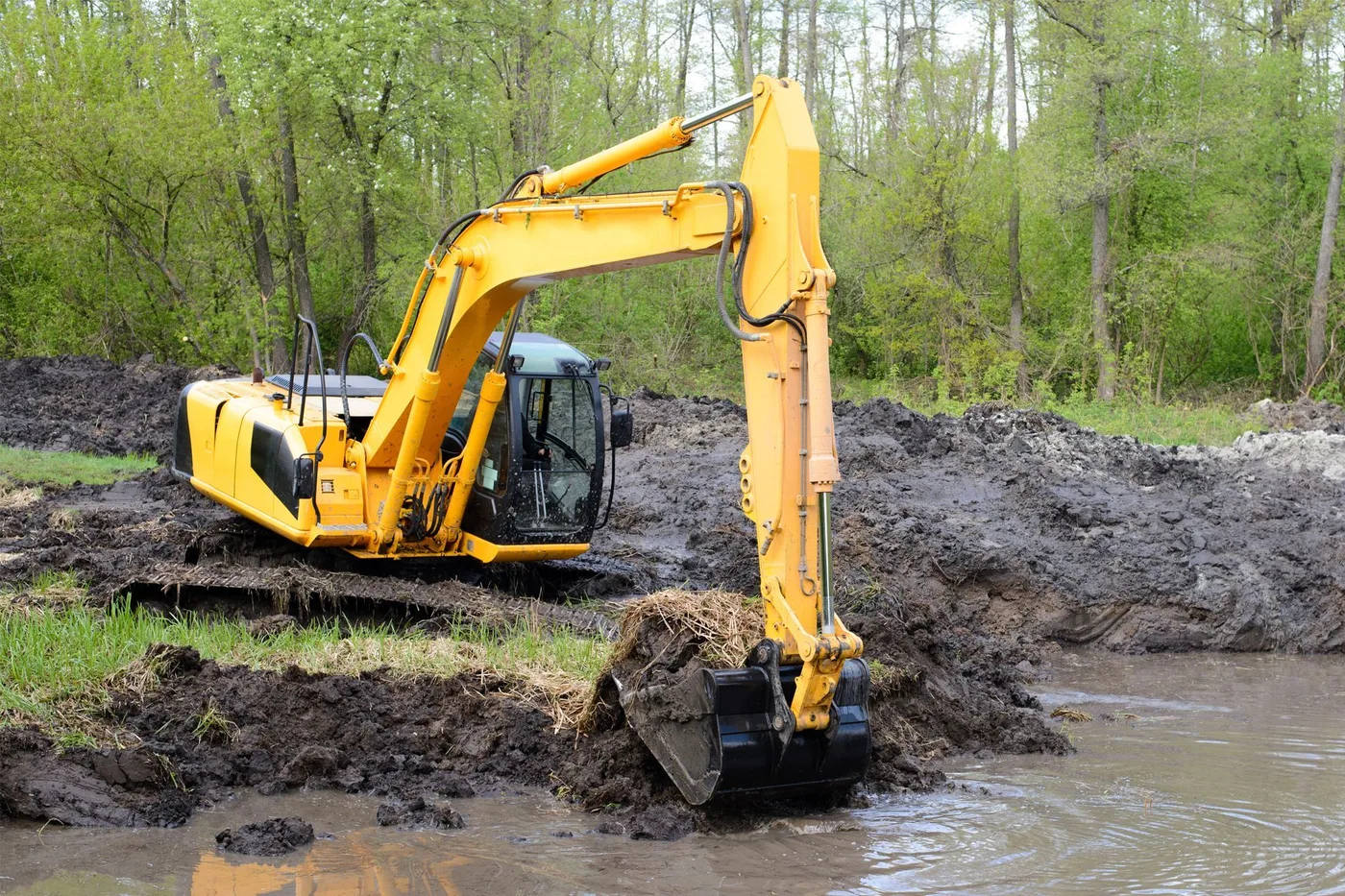
How Deep Should a Pond Be in Texas?
A ranch pond in Texas should be dug eight to twelve feet deep at the deep end. That is what we dig on ranch ground southwest of Houston. Anything shallower becomes a weed bed in a wet year and a mud hole in a dry one.
This post is about dug ranch ponds and lakes: stock tanks for cattle and fishing lakes on acreage. It is not about koi ponds or backyard water gardens. Depth is the first thing we settle in our pond and lake construction service. It decides whether the pond still holds water in August.
The short version is simple. Published minimums are the floor, and Texas heat pushes the real number well above it.
Why do Texas ponds have to be deeper than the national rule?
The national rule of thumb comes from USDA Agriculture Handbook 590. Its map of recommended minimum pond depth starts at a 5 foot pond in the wettest parts of the country. That is a minimum for a pond facing normal seepage and evaporation.
The same handbook adds the part people skip. Go deeper when the water has to last all year. Go deeper again when seepage runs past 3 inches a month. A cattle tank on a Texas ranch is both of those cases at once.
Then there is the heat. The Texas Water Development Board tracks lake evaporation statewide. It runs from less than 45 inches a year in East Texas to past 90 inches out west. Even at the wet end, a pond surface gives up close to four feet a year.
Rain usually keeps up in a normal year. A dry year is another story. In the 2011 drought, net evaporation off Texas reservoirs ran higher than all the municipal water the state used. A tank holding four feet of water has nothing left to give.
How deep should a pond be for each purpose?
Depth follows the job the water does. Here is what the published guides call for, and what we dig on Gulf Coast ground.
| What the pond is for | What the published guides say | What we dig out here |
|---|---|---|
| Stock tank for cattle | One university extension guide tells pond owners to plan on losing 2 feet or more to evaporation and seepage in a drought, on top of what the herd drinks. | Eight to twelve feet in the deep end. One gentle slope where cattle drink, steeper banks everywhere else. |
| Fishing pond for bass and catfish | USDA Handbook 590 sets the floor at 8 feet deep across roughly 1,000 square feet. The Texas farm pond manual adds that a pond over 1 surface acre can carry more than one species. | Eight to twelve feet, plus a few deeper holes so bass have cool water through summer. |
| Recreational ranch lake | The Texas farm pond manual calls for deep water of 12 to 16 feet in part of the pond where summer drawdowns get severe. | Deep holes cut in two or three spots, with shallow shelves at three to four feet where fish spawn. |
Look closely at that fish number. Handbook 590 asks for 8 feet across roughly 1,000 square feet. On a one acre pond, that is only about two percent of the surface.
That sets the floor for one deep spot. The rest of the pond still has to hold water through a Texas August.
Is a deep small pond better than a wide shallow one?
Usually yes, and the math is not close. Evaporation works on surface area. A wide shallow pond loses water faster and has less depth to lose.
Run it on one acre of ground. An acre at four feet of average depth holds four acre-feet of water. That is about 6,450 cubic yards of digging.
Now cut a half acre at ten feet of average depth instead. That holds five acre-feet, or about 8,065 yards. You pay for about 25 percent more digging and get 25 percent more water on half the surface.
The half acre pond also keeps cool water down low in August. The wide one warms all the way to the bottom. Depth is dirt, and dirt is what you pay for. We work that math out in our guide to what a ranch pond costs to build.
What do coastal prairie soils do to pond depth?
Soil decides whether depth holds water at all. The Texas farm pond manual wants compactable soil carrying 30 percent clay or better, which keeps seepage down. Coastal prairie ground across Fort Bend, Brazoria and Wharton counties usually has it. When it does not, our guide on how to seal a pond compares clay, bentonite and liners.
That ground is not uniform. Old creek beds and sand pockets show up where you do not expect them. We watch the material coming out of the hole while we dig.
If we hit sand at depth, the fix is clay. It comes from elsewhere on the place, or off our own dirt pits in Fort Bend County. Finding the sand while the hole is open costs far less than chasing a leak after the pond fills.
How steep should the banks and shelves be?
Shape does as much work as depth. The Texas farm pond manual calls for bank slopes of at least 2.5:1. That keeps wide flats of shallow water out of the pond. Under three feet, sunlight reaches the bottom and feeds weeds.
A university extension drought guide is blunter. It says a pond built right has almost no water under 3 feet deep. We shape banks to drop off quickly for that reason.
Cattle are the exception to steep banks. A stock tank gets one gentle slope where the herd drinks. Steeper banks everywhere else keep the cattle from walking the edges into mud.
Fishing ponds get shelves on purpose. The Texas manual puts a bed of gravel three to six inches thick in water three to four feet deep. Bass and sunfish spawn on it.
What if the tank you already have is too shallow?
Old tanks silt in. A tank dug deep decades ago may hold half that water today. Washed in dirt fills the bottom, and the shallow edges creep toward the middle.
We clean out and deepen existing ponds and tanks. It is the same dig with less shaping: pull the silt, cut the bottom back down, rework the banks.
There is a good rule for judging your own tank. The Texas manual says to size your stocking off the pond’s low-water surface area in an average year. Judge depth the same way, and measure the deep end in late August.
Where does all that dirt go?
A one acre pond at eight feet deep is thousands of yards of dirt. It has to land somewhere on your place, and that belongs in the plan before the first bucket. Some of it builds the dam, keyed into firm clay and packed in lifts.
The rest has value. It can become a house pad built on the same place, or a road bed running out to the barn. That saves buying the same dirt back later.
Whatever you do not want stays on the move. We load it out and run it to our pits. That is what hauling on our tandem dump trucks is for. On a big dig, it moves the price in your favor.
Do you need a permit for a deep pond in Texas?
Depth by itself rarely triggers a permit. Texas Water Code 11.142 lets a landowner store up to 200 acre-feet on their own property. A one acre pond at eight feet deep holds about eight acre-feet, far under that line. Our post on the Texas pond permit rules covers the conditions and the dam safety side.
How we set the depth on your place
Depth is a site question, and the site answers it. We come out and look at where water already runs across the property. We read the material coming out of the test holes. Then we look at what the pond has to do: water cattle, hold fish, or both.
From there we set the deep end and the bank slopes, and price the dig with the dirt handling included. Our minimum project is around $10,000, and a ranch lake in the $50,000 range is the work we like best. Call (281) 750-6510 and tell us what you want the water to do.